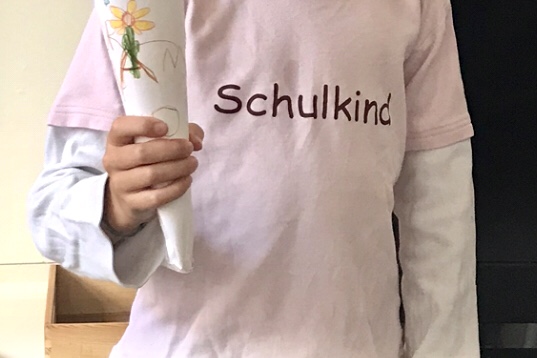
The new school year begins for Bremen's pupils: More than 5,300 children will start school at public primary schools this year. At the same time, for the first time, there is a legal entitlement to all-day care for first-graders.
During the school year press conference at the town hall, Senator for Children and Education Mark Rackles outlined the most important developments and projects. "Bremen has fulfilled the legal entitlement to all-day childcare for all registered children – I consider that a great success. All-day care means more time for children to learn, for sports, music, and their own interests. And it creates more educational opportunities, regardless of how much support a child receives at home. Now the focus is on further expanding all-day care to make this option available to even more children," emphasized Senator Mark Rackles.
Three out of four primary school children use all-day programs
74 percent of Bremen's primary school children already participate in a city-run all-day program – almost 5 percent more than last year. For the 2026/27 school year, 69 out of 87 primary schools will offer all-day programs, which is 13 more than last year.
Bremen's schools continue to grow
- The number of pupils in public schools in the city of Bremen has continued to rise (+949). At private schools, the number of pupils has decreased slightly (-104). As of now, a total of approximately 81,453 pupils will be taught in the new school year (previous year: 80,608).
- In the 2026/2027 school year, exactly 5,394 first-graders at public schools. The number of enrollments has decreased by almost 8 percent compared to the previous year (5,859).
Significant progress in teacher supply
- The staffing situation at Bremen's schools has improved further: In the 2026/27 school year, 6,642 teachers are working at general education schools – the highest number in years. In the 2024/25 school year, the number was 6,365. The number of open positions is currently 34, an all-time low. Of the 150 advertised positions, 116 are currently filled, and an additional 43 teachers have been recruited for the substitute pool. The remaining 34 open positions are permanently advertised; the substitute pool, designed for up to 200 positions, is also being continuously filled. In the event of longer-term absences, the Stadtteilschule e. V. (a local association of secondary schools) provides support with 419 master's and bachelor's graduates.
- Of the 141 trainee teachers trained in Bremen who applied for positions in the Hanseatic city, 101 were hired. The number of school social workers and non-teaching staff is also being increased; for example, the number of social workers is rising by a good 7 percent from 176 in the 2024/25 school year to 189 this school year.
- Shortages persist at individual schools in Bremen – particularly in terms of regional needs (e.g., Bremen-North, Überseestadt) and subject areas (e.g., special education). The Senator for Children and Education actively allocates resources to schools in need, taking regional considerations into account.
The education initiative is taking concrete form: strengthening language, mathematics, and health
The Senator for Children and Education is continuing the "Initiative for Improved Educational Quality" launched in February. The focus is on better performance in language and mathematics, as well as strengthening the health and well-being of children and young people.
- called "Mit-Sprache" (Linguistic Participation) is launching as part of the "Startchancen" (Starting Opportunities) program, offering early language support in small groups. Successful mathematics programs are being consolidated and implemented at the "Startchancen" schools starting this school year. Furthermore, the first primary schools will begin using the IQHB dashboard for data-driven school development this fall.
- Mental health is also being specifically strengthened: Teachers and educational staff are being trained as mental health first responders . This strengthens schools' ability to recognize psychological stress early and offer support, as almost a quarter of young people are affected by mental health problems every year.
Senator Mark Rackles emphasizes: “When children or young people are experiencing mental health problems, the first warning signs are often subtle and easily overlooked. This makes it all the more important that we look out for them earlier and offer support before a problem turns into a crisis.”
Inclusion further strengthened: High staffing levels and targeted support
- Inclusive education in Bremen is being further expanded: For the 2026/27 school year, 176 first-grade students with special educational needs in the area of intellectual development (GE) were enrolled – ten more than the previous year, with around 60 percent of them also having additional support needs within the autism spectrum . The number of GE locations at Bremen schools has more than doubled since 2017/18, rising from 39 to 81 this school year.
- To meet the ongoing staffing needs, further specialist training is being conducted: By the end of 2026/27, 30 special education teachers will receive advanced training. In 2027, 170 teachers will follow with certified training in working with autism. Additionally, for the first time in the Blumenthal region, 20 specialists will be trained for multi-professional teams.
Digitalization of schools continues to progress
- The Digital Pact for Schools laid important foundations for a modern digital education infrastructure. The Digital Pact 2.0 continues this path. Bremen has access to up to approximately €20.4 million in federal funding for this purpose, while contributing €4.7 million from state funds.
- The 1:1 iPad program is being gradually transitioned to a leasing model . 50,000 students will receive new devices. In the first and second grades of elementary schools, equipment will be provided based on need and aligned with the schools' media concepts.
- At the same time, we are strengthening youth protection: Social media services are centrally blocked on the school network, and the most common services such as Instagram, TikTok and Whatsapp are additionally blocked directly on the iPads – even outside the school network.
Children's and Education Senator Mark Rackles: "We want digital education to be a matter of course, but also safe and responsible. That's why we are continuing to invest in modern equipment and strengthening the protection of children and young people. However, technical restrictions cannot replace supervision by teachers and parents."
The educational building initiative will continue
- This school year, Bremen is opening two new school buildings : the school at Alten Postweg and the Fährer Flur school. Capacity-expanding replacement and renovation projects will also take place in 2026/27 at locations including the school on Nordstraße, the Oberschule im Park, the Oberschule Roter Sand, and the Oberneuland school.
- In addition, numerous other renovations and modernizations completed for the new school year. These range from the refurbishment of the third floor and the expansion of the schoolyard at the Überseestadt secondary school on Grenzstraße, to the creation of quiet rooms for the after-school care area of the Alt-Aumund primary school, and the renovation of the sports hall on Delfter Straße.
- In addition to various building maintenance and renovation measures carried out by Immobilien Bremen (Bremen Real Estate), the Senator for Children and Education is currently planning and implementing approximately 150 of its own construction projects to improve and adapt existing buildings to current school requirements. This will create better learning and recreational conditions at many locations.
Source: More than 5,300 children start new schools in Bremen – Senate Press Office, 13.08.2026